
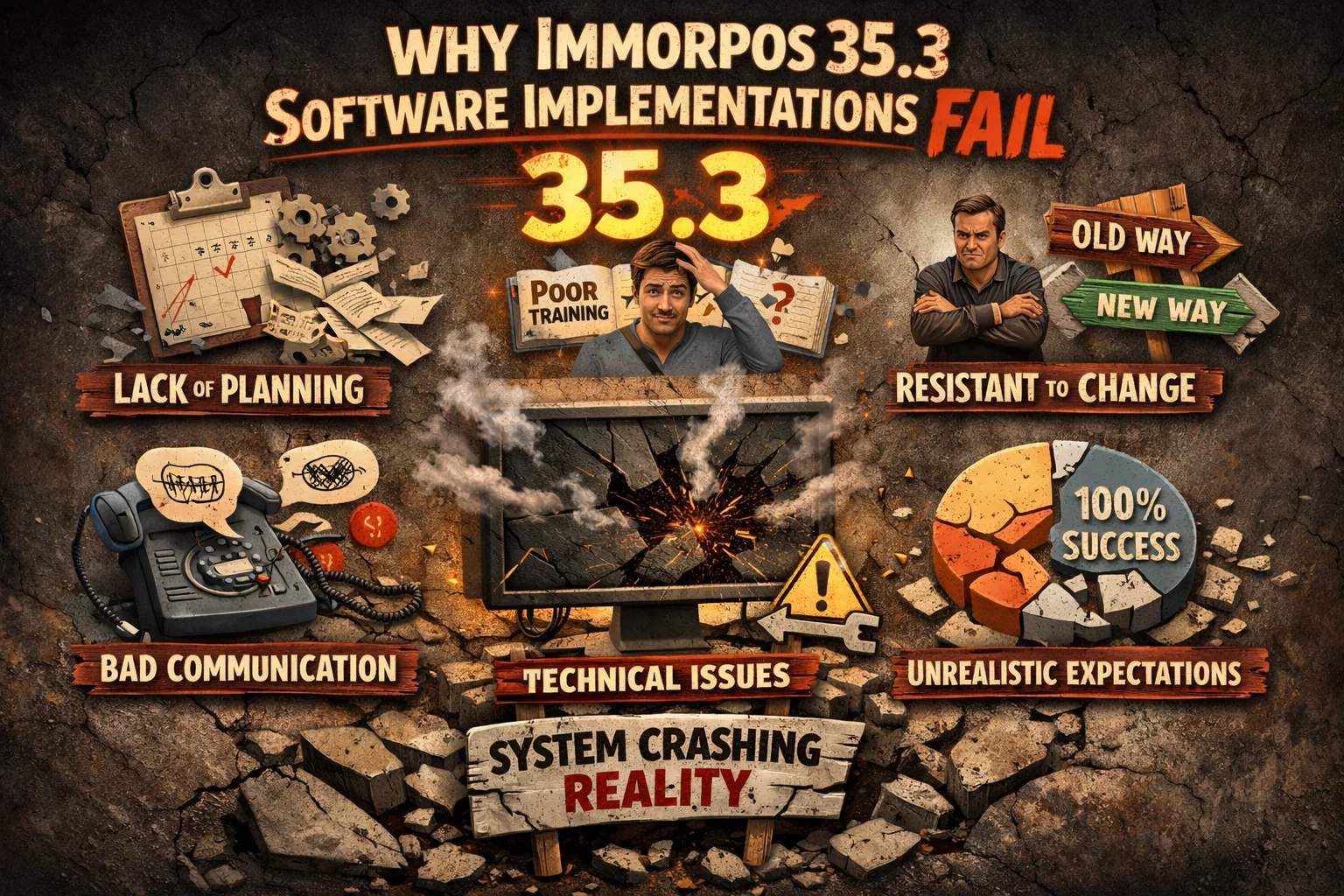
Software implementations are supposed to streamline operations, improve efficiency, and deliver measurable value. Yet, many organizations find themselves frustrated when systems like Immorpos35.3 fail to meet expectations. While the technology itself may be powerful, failure usually stems from how it is planned, executed, and adopted—not just the software.
Understanding why Immorpos35.3 software implementations fail can help organizations avoid costly mistakes and achieve better outcomes.
Lack of Clear Objectives
One of the most common reasons for failure is starting without clearly defined goals. Companies often adopt Immorpos35.3 because competitors are using it or because it promises advanced features. However, without identifying specific problems the software should solve, implementation becomes directionless.
When objectives are vague, teams struggle to measure success. This leads to confusion, misaligned priorities, and ultimately disappointment with the results.
Poor Planning and Strategy
Jumping into implementation without a detailed plan is another major issue. Immorpos35.3 is not a plug-and-play solution—it requires careful configuration, testing, and integration.
Organizations that skip proper planning often underestimate timelines and costs. They may fail to account for data migration, system compatibility, or staff training. As a result, projects fall behind schedule and exceed budgets.
A solid roadmap with clear milestones is essential to keep everything on track.
Inadequate Training and User Adoption
Even the most advanced software will fail if people don’t know how to use it. Many organizations overlook the importance of training, assuming employees will “figure it out” over time.
This approach leads to low adoption rates. Employees may resist using Immorpos35.3 because they find it confusing or disruptive to their workflow. Some may revert to old systems, reducing the effectiveness of the new implementation.
Consistent training, user support, and feedback loops are key to ensuring smooth adoption.
Weak Leadership and Stakeholder Involvement
Successful implementations require strong leadership and active involvement from key stakeholders. When leadership is disengaged, projects lose direction and momentum.
Stakeholders play a critical role in aligning the software with business needs. Without their input, the system may be configured in ways that don’t support real-world processes.
Organizations that fail to involve the right people early on often face resistance, miscommunication, and poor outcomes.
Customization Overload
Immorpos35.3 offers a high level of customization, which can be both a strength and a weakness. Some organizations try to tailor every aspect of the software to match their existing processes.
This often leads to overcomplication. Excessive customization increases development time, introduces bugs, and makes future updates difficult.
Instead of bending the software entirely to fit old workflows, it’s often better to adapt processes to align with the system’s best practices.
Data Migration Challenges
Data migration is one of the most complex parts of any software implementation. Transferring data into Immorpos35.3 without errors requires careful planning and validation.
Organizations that rush this step risk importing incomplete, outdated, or incorrect data. This can compromise the system’s performance and lead to poor decision-making.
Ensuring data accuracy and integrity before, during, and after migration is critical for long-term success.
Integration Issues
Immorpos35.3 rarely operates in isolation. It often needs to integrate with other systems such as CRM platforms, accounting tools, or inventory management software.
Poor integration can cause data silos, inconsistencies, and operational inefficiencies. If systems don’t communicate properly, users may lose trust in the software.
Testing integrations thoroughly and ensuring compatibility is essential to avoid these problems.
Unrealistic Expectations
Another reason why Immorpos35.3 software implementations fail is unrealistic expectations. Some organizations expect immediate results without recognizing the time and effort required for a successful rollout.
Software implementation is a process, not an instant transformation. It involves learning curves, adjustments, and continuous improvement.
Setting realistic timelines and expectations helps teams stay motivated and focused.
Lack of Ongoing Support and Maintenance
Implementation doesn’t end once the software goes live. Without ongoing support, updates, and optimization, the system can quickly become outdated or inefficient.
Organizations that treat implementation as a one-time project often neglect long-term maintenance. This leads to performance issues and reduced value over time.
Regular updates, monitoring, and user feedback are necessary to keep the system running effectively.
Resistance to Change
People naturally resist change, especially when it disrupts familiar routines. Introducing Immorpos35.3 can create uncertainty and discomfort among employees.
If change management is not handled properly, resistance can slow down or even derail the implementation.
Communicating the benefits, addressing concerns, and involving users in the process can make a significant difference.
Conclusion
The failure of Immorpos35.3 software implementations is rarely due to the software itself. Instead, it stems from poor planning, lack of training, weak leadership, and unrealistic expectations.
By focusing on clear objectives, strong strategy, effective training, and ongoing support, organizations can significantly improve their chances of success. Avoiding common pitfalls and prioritizing user adoption will ensure that Immorpos35.3 delivers the value it promises.
In the end, successful implementation is less about the tool and more about how people use it.